
Views: 0 Author: Site Editor Publish Time: 2026-08-11 Origin: Site


When embarking on a large-scale residential or commercial construction project, selecting the right fenestration partner is one of the most critical decisions a developer, architect, or homeowner can make. Sourcing high-performance products requires looking beyond surface-level aesthetics and diving deep into the manufacturing processes. Knowing exactly what to ask an aluminum windows factory about their quality control protocols can mean the difference between installing long-lasting, energy-efficient fixtures and dealing with costly replacements down the line. A rigorous evaluation of a facility's production standards, material sourcing, and testing methodologies ensures that the final products will meet stringent architectural demands and environmental challenges. By asking targeted, highly technical questions, buyers can separate industry-leading producers from substandard suppliers.
The global supply chain for building materials is vast and complex, making it essential to establish clear lines of communication regarding engineering specifications, hardware integration, and thermal performance. When evaluating a potential manufacturing partner, the conversation must move past basic pricing and lead times. It is imperative to interrogate their adherence to international certifications, their approach to custom configurations, and their specific methodologies for ensuring weather resistance and structural integrity. This comprehensive guide outlines the critical inquiries you must present to any prospective supplier, utilizing specific benchmarks such as those found in premium casement window lines to illustrate what top-tier manufacturing looks like in practice.
The foundation of any successful procurement strategy begins with a thorough vetting of the primary production facility. An aluminum windows factory is not merely an assembly line; it is a highly specialized engineering environment where raw materials are transformed into precision-engineered architectural elements. When you begin your dialogue with a facility, your first set of questions should revolve around their overarching philosophy regarding quality assurance. You must ask how they define quality within their operational framework and what specific metrics they use to measure success. A reputable facility will have a documented, transparent process that tracks every component from the moment it enters the loading dock to the final pre-shipment inspection.
Furthermore, it is crucial to ask about the factory's internal auditing processes. Do they rely solely on end-of-line inspections, or do they implement continuous monitoring at every stage of fabrication? End-of-line testing is often insufficient because it only identifies defects after the product is fully assembled, leading to wasted materials and delayed shipments. Instead, a world-class facility will employ in-process quality checks, where technicians measure tolerances during extrusion, cutting, milling, and assembly. Asking for detailed documentation of these in-process checks provides invaluable insight into the facility's commitment to precision and consistency.
To truly gauge a facility's capabilities, you must understand the comprehensive role of an elite manufacturing partner. You should ask the facility how they manage the integration of diverse materials, such as the marriage of aluminum alloys with advanced thermal barriers and complex glazing units. A top-tier producer does not just cut and screw metal together; they engineer complete fenestration systems. Inquire about their engineering department and their ability to interpret complex architectural drawings. Ask how they handle discrepancies between theoretical designs and practical manufacturing constraints. Their ability to provide proactive engineering solutions is a strong indicator of their overall competence and reliability as a long-term supply chain partner.
The structural integrity and longevity of any fenestration product are fundamentally dictated by the quality of the raw materials used in its construction. Therefore, your questioning must heavily focus on the facility's supply chain for aluminum billets and their extrusion processes. Ask the factory to specify the exact grade of aluminum alloy they utilize for their primary profiles. The industry standard for high-performance architectural applications is 6063-T5 aluminum alloy. You should ask if they exclusively use prime billets or if they incorporate recycled scrap, and if so, what percentage of scrap is permitted without compromising the alloy's structural and chemical properties.
Beyond the alloy itself, you must inquire about the extrusion process. Ask about the precision of their extrusion dies and how frequently those dies are inspected, cleaned, and replaced. Worn dies lead to dimensional variations in the aluminum profiles, which in turn cause assembly issues, poor weather sealing, and compromised structural integrity. Furthermore, ask about their aging process. The "T5" designation in 6063-T5 indicates that the aluminum has been cooled from an elevated temperature shaping process and then artificially aged. Ask the factory to detail their temperature control protocols during this artificial aging process, as precise thermal management is critical for achieving the optimal balance of tensile strength and ductility.
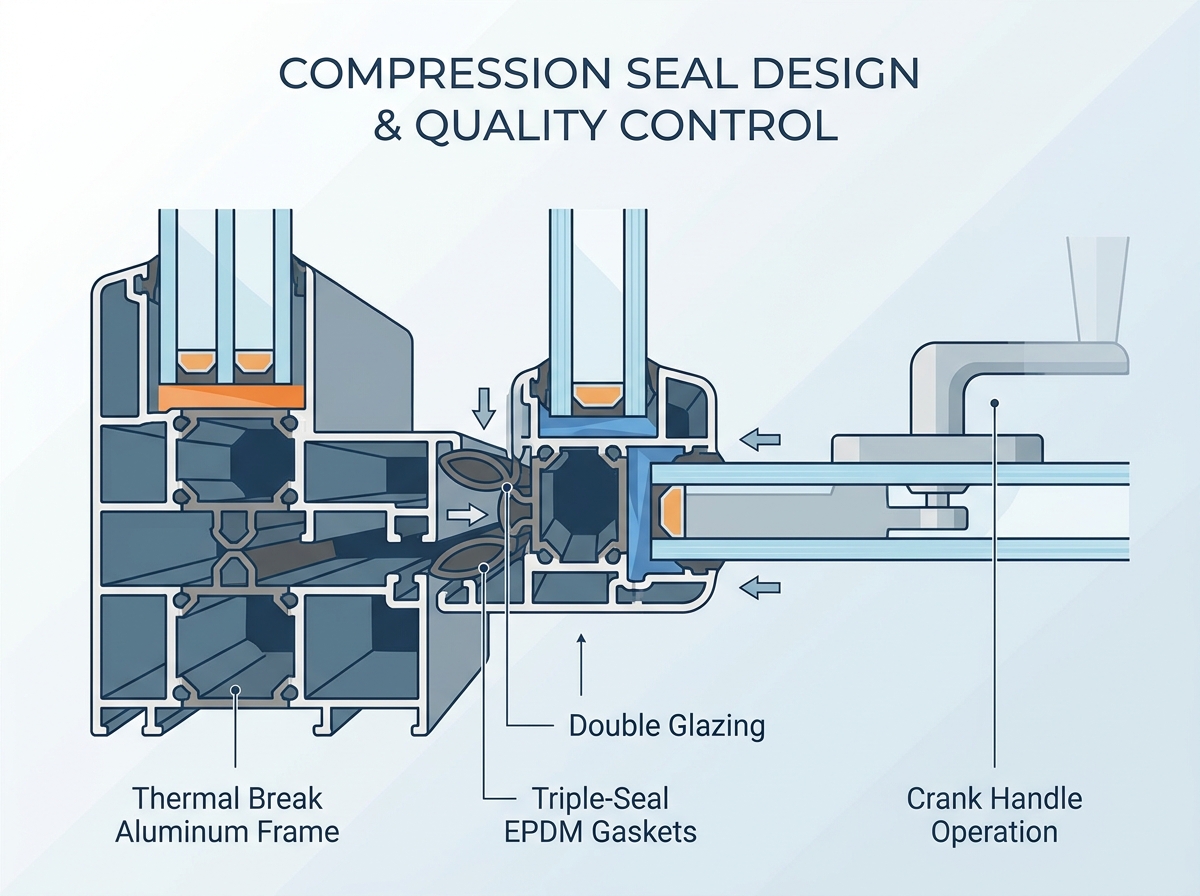
When evaluating premium products like DAW Casement Windows, you will note they are constructed from 6063-T5 Thermal Break Aluminum Alloy. You must ask the factory how they implement their thermal break technology. A thermal break is a non-conductive material, typically polyamide, inserted between the interior and exterior aluminum profiles to prevent the transfer of heat and cold. Ask the factory about the width and composition of their thermal struts. Inquire about the mechanical knurling and rolling process used to join the aluminum and the polyamide. If this joining process is not executed with absolute precision, the structural integrity of the entire window frame is compromised, leading to potential failure under high wind loads or extreme temperature fluctuations.
A window is only as secure and functional as the hardware that operates it. When auditing a manufacturing facility, a significant portion of your questions must be dedicated to their hardware selection and integration processes. Ask the factory which hardware brands they partner with and why. Inquire about the cycle testing they perform on hinges, handles, and locking mechanisms. A high-quality casement window, for example, relies heavily on its crank handles for easy opening and closing, especially in tight spaces or when installed above sinks and countertops. You must ask the factory how they test these crank mechanisms for long-term durability, ensuring they will not strip, bind, or corrode over decades of daily use.
Security is a paramount concern for any building occupant, making the locking system a critical point of inquiry. Ask the factory to detail the specific locking architectures they employ. Single-point locks are generally insufficient for modern security and weatherproofing standards. Instead, you should ask if they standardly integrate multi-point locking systems. Inquire about the materials used for the locking cams and keepers, ensuring they are constructed from corrosion-resistant metals like stainless steel. Ask how the factory ensures the precise alignment of these multi-point systems during assembly, as even a millimeter of deviation can result in a window that fails to lock smoothly or seal tightly.
Using premium casement designs as a benchmark, you should expect features like multi-point security locking systems for enhanced security. When speaking with the factory, ask them to explain the exact mechanics of their multi-point systems. How many locking points are engaged when the handle is turned? How does the system distribute the locking force along the entire length of the sash? This distribution of force is not only critical for preventing forced entry but also for ensuring uniform compression against the weather stripping. Ask the factory for testing data demonstrating the system's resistance to forced entry and its performance under simulated wind-driven rain conditions.
One of the primary functions of any window is to protect the interior environment from the elements. Therefore, your dialogue with the factory must rigorously examine their weatherproofing technologies. Ask the facility to explain their overall philosophy on water management. Do they rely solely on barrier systems, or do they incorporate pressure-equalized, drained designs? Ask about the specific types of weather stripping they use. Polyurethane foams and basic vinyl seals degrade quickly under UV exposure and extreme temperatures. You should ask if they utilize high-performance elastomers, and specifically request details on their gasket geometries and insertion methods.
Furthermore, ask the factory about their sash design and how it interacts with the main frame to create an airtight barrier. For instance, high-quality casement windows utilize a compression seal design to create an airtight and weather-resistant barrier. Ask the factory how they calculate and test the compression force required to achieve optimal sealing without making the window difficult to operate. Inquire about the corner construction of their gaskets; ask if they use continuous, vulcanized corners or if the gaskets are simply cut and glued, as glued corners are notorious points of failure for air and water infiltration.
When demanding top-tier performance, you should look for specifications such as Triple-seal EPDM Gaskets. EPDM (Ethylene Propylene Diene Monomer) is a synthetic rubber highly resistant to UV radiation, ozone, and thermal aging. Ask the factory if their EPDM gaskets are co-extruded and how they ensure the gaskets retain their memory and elasticity over time. Ask them to explain the function of each of the three seals in a triple-seal system—typically an acoustic interior seal, a central weather seal, and an exterior dust seal. Understanding how the factory engineers these overlapping systems will give you confidence in their ability to deliver products that perform flawlessly in harsh climates.
The glazing unit typically comprises the largest surface area of a window, making it the most critical component for thermal and acoustic performance. When interviewing a factory, you must ask extensive questions about their glass sourcing and processing capabilities. Ask if they process their own insulated glass units (IGUs) in-house or if they outsource to a third-party glass manufacturer. If they process in-house, ask about their automated cutting, washing, and sealing lines. Inquire about the specific types of glass they offer, ensuring they can provide Double/Triple Glazing, Low-E coatings, Argon-filled cavities, and Tempered safety glass. Ask how they verify the argon gas retention rates in their IGUs over time.
Acoustic performance is increasingly vital in urban and high-density residential developments. Ask the factory how they engineer their windows for sound insulation. Do they simply rely on thicker glass, or do they employ asymmetrical glazing configurations (using panes of different thicknesses to disrupt different sound frequencies)? Ask about the specific STC (Sound Transmission Class) ratings their products achieve. A premium window system should be capable of achieving an STC Rating up to 40-45 dB. Ask the factory to provide certified acoustic test reports from independent laboratories to substantiate these claims, rather than relying on theoretical calculations.
When discussing glazing, ask the factory to explain the specific Low-E (Low-Emissivity) coatings they apply. Are they hard-coat or soft-coat Low-E? On which surfaces of the IGU are the coatings applied to optimize solar heat gain coefficients (SHGC) and U-values for your specific climate zone? Furthermore, ask about their spacer bar technology. Traditional aluminum spacer bars create a thermal bridge at the edge of the glass, leading to condensation. Ask if they utilize warm-edge spacer technology, such as silicone foam or composite materials, to improve the overall thermal efficiency of the glazing unit and reduce the risk of edge condensation.
Architectural projects rarely adhere to a one-size-fits-all approach. Therefore, a factory's ability to customize their products to meet specific design intents is a crucial metric of their capability. Ask the factory about their range of available styles and configurations. For example, can they produce Single, Double/French, and Push-Out styles within the same product family? Ask about their finishing options. A high-quality facility should offer a diverse palette, including Matte Black, Anthracite Grey, Classic White, custom RAL colors, or wood grain finishes. Inquire about their powder coating or anodizing processes. Ask about the thickness of the powder coat layer and the pre-treatment processes used to ensure maximum adhesion and resistance to fading, chalking, and salt-spray corrosion.
Additionally, ask about the structural limitations of their custom configurations. For instance, premium casement windows are often designed without a center meeting rail to provide an unobstructed view. Ask the factory how they engineer the frame and sash to maintain structural rigidity and wind load resistance when large spans of glass are utilized without mullions or meeting rails. Ask about their maximum size limitations and the engineering calculations they use to determine when heavy-duty hardware or reinforced profiles are necessary to support oversized custom units.
For large-scale developments, you may require Original Equipment Manufacturer services. When discussing OEM capabilities, ask the factory about their prototyping process. How quickly can they turn an architectural concept into a fully functional, testable prototype? Ask about their tooling costs and lead times for custom extrusion profiles. Furthermore, inquire about their ability to integrate secondary systems, such as screens. Ask if their frames are natively compatible with integrated fiberglass mesh or stainless steel security mesh screens, and how these screens are mounted to ensure they do not interfere with the operation of the window hardware or compromise the aesthetic lines of the frame.
Verbal assurances of quality are insufficient in the commercial construction industry; documented compliance with international standards is mandatory. When evaluating a factory, you must ask for comprehensive proof of their certifications. Ask if their manufacturing processes and quality management systems are certified to ISO9001 standards. This certification demonstrates a facility's commitment to consistent quality, continuous improvement, and rigorous documentation. However, ISO9001 only covers the management system; you must also ask for product-specific performance certifications.
Ask the factory if their products have been tested and certified to meet regional and international building codes. For the Australian market, ask for AS2047 certification, which dictates mandatory performance requirements for windows in buildings. For the European market, demand proof of CE marking, ensuring compliance with health, safety, and environmental protection standards. For the North American market, ask for NFRC (National Fenestration Rating Council) certification, which provides standardized ratings for energy performance, including U-factor, Solar Heat Gain Coefficient, and Visible Transmittance. A factory's ability to readily produce these certifications is a strong indicator of their global competence and product reliability.
When reviewing these certifications, ask the factory about the frequency of their re-testing protocols. Building codes and energy standards evolve, and a certification from a decade ago may no longer be valid or relevant. Ask how they ensure ongoing compliance as they update their extrusion profiles or change hardware suppliers. Furthermore, ask if they maintain an in-house testing laboratory. While third-party certification is essential, a factory that possesses its own testing equipment for air infiltration, water penetration, and structural wind load testing demonstrates a proactive approach to quality assurance, allowing them to identify and rectify potential issues long before the products are sent for official, independent certification.
Finally, your questions should bridge the gap between manufacturing specifications and practical, real-world applications. Ask the factory how their specific product features translate into tangible benefits for the end-user. For example, ask how the fact that a casement sash opens fully to direct fresh air into the home for maximum ventilation impacts indoor air quality and passive cooling strategies. Inquire about the specific rooms and environments where their products excel. Premium casement windows, for instance, are ideal for kitchens and bathrooms requiring ventilation, while also being highly suitable for living rooms and bedrooms to provide expansive views.
Ask the factory about the operational kinematics of their windows. For example, if a window is intended for installation above sinks or countertops, ask how the crank operation facilitates easy access and operation without requiring the user to lean awkwardly over the counter. Furthermore, ask about the default configurations and the process for requesting variations. For example, if the standard opening type is Outswing (Left or Right side hinged), ask what the specific engineering or lead-time implications are when Inswing configurations must be specifically requested. Understanding these practical nuances ensures that the products you source will not only meet technical specifications but also enhance the daily lives of the building's occupants.
When discussing practical applications, delve into the longevity of the aesthetic finishes. Ask the factory how their wood grain finishes are applied—is it a sublimation process or a foil lamination? Ask how these finishes perform under intense UV exposure compared to standard powder coats like Classic White or Anthracite Grey. Additionally, ask about the maintenance requirements for their integrated screen systems. How easily can a homeowner remove a stainless steel security mesh screen for cleaning, and does the mounting hardware require specialized tools? These seemingly minor details significantly impact the long-term satisfaction of the end-user and reflect the factory's holistic approach to product design.
DAW Casement Windows represent a highly engineered fenestration solution, constructed from durable 6063-T5 Thermal Break Aluminum Alloy and featuring advanced multi-point security locking systems. Designed to maximize both aesthetics and functionality, these windows eliminate the center meeting rail for unobstructed views while utilizing a compression seal design and Triple-seal EPDM gaskets to ensure superior weather resistance and an STC sound insulation rating of up to 40-45 dB. With versatile configurations including Single, Double/French, and Push-Out styles, smooth crank handle operation perfect for hard-to-reach areas like above kitchen sinks, and compatibility with both fiberglass and stainless steel security meshes, they offer exceptional practical value. Backed by rigorous AS2047, CE, NFRC, and ISO9001 certifications, and available in a wide array of premium finishes including custom RAL and wood grain, these outswing windows (with inswing available upon request) are the ideal, high-performance choice for modern kitchens, bathrooms, living rooms, and bedrooms requiring optimal ventilation, expansive views, and uncompromising quality.


