
Views: 0 Author: Site Editor Publish Time: 2026-07-29 Origin: Site


Modern building envelopes require fenestration that blocks weather while maintaining structural rigidity. Upgrading to a high-performance aluminum casement window directly impacts HVAC loads, indoor comfort, and property value. Older metal frames failed at thermal retention, acting as conduits for exterior temperatures. Current engineering solves this through advanced polymer barriers and multi-point locking hardware. This guide details the mechanics of compression seals, polyamide struts, and glazing configurations. We analyze how specific frame designs prevent air infiltration and thermal bridging. You will learn how to specify units based on climate zones and structural requirements, ensuring your window schedule meets strict energy codes without sacrificing architectural sightlines.
The core advantage of this window style lies in its mechanical operation. Unlike sliding sashes that glide along tracks, a side-hinged sash presses directly into the frame. This action creates a continuous, airtight barrier that resists wind loads and prevents conditioned air from escaping the building envelope. Understanding the individual components helps clarify why this design outperforms legacy systems.
When you close the sash, it pulls tight against weatherstripping along the entire perimeter. This compression seal acts much like a refrigerator door. It leaves no gaps for air to escape or enter. Sliding and double-hung windows rely on brush seals. Brush seals degrade over time, collect debris, and inherently allow more air leakage. The compression mechanism actively fights wind pressure. As wind blows against the exterior glass, it pushes the sash tighter into the weatherstripping, reinforcing the seal. Installers often use EPDM (Ethylene Propylene Diene Monomer) or silicone gaskets because these materials resist UV degradation and maintain their memory after thousands of compression cycles.
Field tests consistently show that compression seals maintain their integrity far longer than friction-based seals. When a building faces high wind loads, the positive pressure forces the sash inward. On a side-hinged unit, this pressure compresses the gasket further. On a sliding unit, the same pressure rattles the sash within its track, allowing cold air to bypass the weatherstripping and enter the living space.
Heavy-duty rotators and multipoint locking hardware define the modern crank casement window. Turning the handle leverages significant mechanical force. This force engages locks at the top, middle, and bottom of the frame simultaneously. Multiple locking points prevent the sash from warping or bowing under severe wind loads. You get a uniform seal that stops draft penetration completely.
The internal gears of these operators are typically machined from hardened steel or brass, housed in corrosion-resistant zinc or aluminum casings. The mechanical advantage provided by the crank allows users to easily pull heavy, triple-glazed sashes tightly against the frame. Without this mechanical leverage, achieving the necessary compression on the weatherstripping would require excessive physical force. Furthermore, the multipoint lock acts as a structural reinforcement, tying the sash to the main frame at several intervals, which distributes wind loads evenly across the entire extrusion.
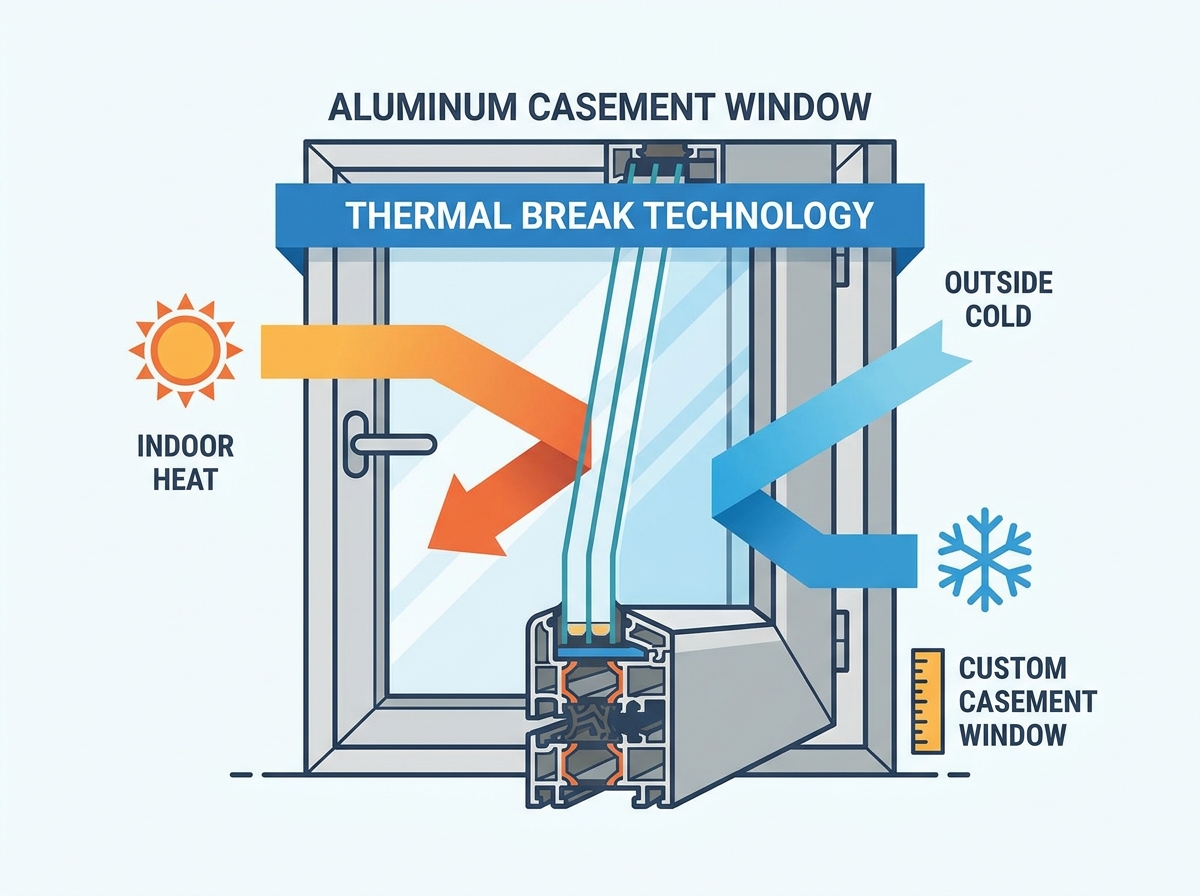
Aluminum conducts heat easily. Without intervention, a metal frame pulls winter cold indoors and transfers summer heat inside. The solution is the thermal break casement window. Manufacturers split the interior and exterior aluminum profiles. They insert a reinforced polyamide or polyurethane insulating strut between them. This barrier stops thermal conduction instantly. The exterior frame can freeze while the interior frame remains at room temperature. This technology stops condensation and drastically reduces heat loss.
Polyamide struts are mechanically crimped into the aluminum extrusions during the manufacturing process. This composite assembly maintains the structural rigidity required for large glass spans while completely severing the thermal bridge. The width of the thermal break directly correlates to its insulating capacity. Standard breaks measure around 14mm to 20mm, but high-performance units designed for extreme northern climates may utilize struts up to 35mm wide. Some manufacturers also insert closed-cell foam into the hollow chambers of the aluminum extrusion to further disrupt convective heat transfer within the frame itself.
Upgrading fenestration yields measurable returns on energy consumption. The right frame and glass combination stabilizes interior climates and reduces reliance on mechanical heating and cooling. Building owners often underestimate the thermal load placed on a structure by outdated windows.
Industry data indicates that replacing outdated, single-pane or poorly sealed units with modern insulated aluminum frames improves residential thermal retention significantly. Homes can see up to a 30% increase in overall energy efficiency. A tight building envelope keeps conditioned air inside where it belongs. When you eliminate the drafts associated with old sliding tracks and uninsulated metal frames, the heating and cooling systems do not have to run continuously to maintain the thermostat setpoint.
This benchmark is supported by blower door tests conducted before and after window retrofits. Air changes per hour (ACH) drop dramatically when compression-sealed units replace friction-sealed units. The reduction in uncontrolled air infiltration is often the single largest factor in lowering monthly utility consumption.
Drafty frames create uncomfortable hot and cold spots near perimeter walls. High-performance aluminum profiles eliminate these temperature fluctuations. Consistent ambient temperatures reduce the cycling frequency of your HVAC system. Less frequent cycling lowers daily energy consumption and prolongs the lifespan of your heating and cooling equipment.
When a room has cold spots near the windows, occupants typically raise the thermostat to compensate, overheating the interior zones of the house. Thermally broken frames with high-performance glazing maintain an interior surface temperature that closely matches the room's ambient temperature. This eliminates the convective loops that cause drafts. When the air near the window doesn't cool and drop to the floor, the entire room feels more comfortable at a lower thermostat setting.
A premium frame requires premium glazing. The thermal break works best when paired with double or triple-pane insulated glass units (IGUs). The frame and the glass must work as a cohesive system. Installing standard clear glass in a thermally broken frame negates the frame's benefits.
Architects favor aluminum for its strength-to-weight ratio. This structural rigidity supports massive glass expanses without requiring bulky sightlines. Wood frames warp under heavy loads, and vinyl frames expand and contract significantly with temperature changes. Aluminum remains stable, allowing for precise operation year after year.
You must configure your windows for your specific geographic zone. A custom casement window allows you to specify exact Solar Heat Gain Coefficient (SHGC) and U-factor ratings. Southern climates require a low SHGC to block solar heat. Northern climates benefit from a higher SHGC to capture passive solar warmth in winter. The U-factor measures overall insulation; lower numbers indicate better heat retention.
For example, a building in Arizona needs glass that blocks the sun's heat but allows visible light to pass through. This requires a specialized Low-E coating applied to the number two surface of the IGU. Conversely, a building in Minnesota needs to trap interior heat while allowing the winter sun to warm the space. This requires a different Low-E coating applied to the number three surface, paired with a highly insulated frame to prevent nighttime heat loss.
Aluminum frames handle heavy, triple-glazed units effortlessly. You can design floor-to-ceiling operable vents that maintain strict thermal integrity. Frame finishes also play a role in longevity and performance. Powder coating provides a thick, durable layer that resists fading and chipping. Anodizing integrates color directly into the metal surface, offering extreme weather resistance in coastal environments. Both finishes protect the structural core from degradation.
Because aluminum is extruded, manufacturers can create complex profiles that incorporate integrated drip caps, specialized glazing pockets, and concealed drainage weep holes. This allows for flush exterior sightlines and hidden hinges, providing a clean, modern aesthetic without compromising the weather seal. The structural integrity of the 6063-T5 aluminum alloy commonly used in these extrusions ensures that even massive, custom-sized sashes will not sag over time.
Understanding how different operating styles perform helps clarify why side-hinged units dominate energy efficiency metrics. The mechanics of how a window opens and closes dictate its long-term ability to seal out the weather.
| Window Style | Sealing Mechanism | Air Infiltration Risk | Structural Integrity Under Wind Load |
|---|---|---|---|
| Casement | Compression against EPDM weatherstripping | Very Low | Excellent (wind pushes sash tighter into frame) |
| Double-Hung | Friction / Brush seals along vertical tracks | Moderate to High over time | Fair (sashes can rattle in tracks) |
| Sliding | Track-bound brush seals | High (tracks collect debris and wear down seals) | Poor (large sashes bow under pressure) |
| Awning | Compression against EPDM weatherstripping | Very Low | Excellent (similar to casement, hinged at top) |
When opened, the outward-swinging sash catches passing breezes and directs them indoors. This wind scoop effect maximizes passive indoor cooling. Efficient natural ventilation reduces your reliance on air conditioning during mild weather. Sliding windows simply cannot capture cross-breezes as effectively because they do not project outward from the building envelope.
By strategically placing side-hinged units on opposite sides of a room or building, you can create a powerful cross-ventilation effect. The open sash acts as an air foil, funneling fresh air into the space while pushing stale air out the opposite side. This passive cooling strategy is a cornerstone of sustainable building design and relies heavily on the specific geometry of the outward-swinging sash.
Do not rely on aesthetics alone when selecting building materials. Verify performance through independent testing and proper installation protocols. A high-quality unit installed poorly will perform worse than a mediocre unit installed perfectly.
The installation phase is critical. The gap between the window frame and the rough opening must be sealed completely. Low-expansion foam provides both an air seal and thermal insulation. Fiberglass insulation only filters the air; it does not stop drafts. Furthermore, the exterior flashing must be integrated with the building's weather-resistant barrier (WRB) in a shingle-lap fashion to prevent water intrusion.
Investing in thermally broken aluminum profiles secures long-term indoor comfort and structural durability. You eliminate drafts, reduce HVAC strain, and protect your property against harsh weather conditions. The initial material upgrade pays dividends through decades of reliable operation and reduced utility consumption.
A: Older, solid aluminum frames cause condensation because they transfer cold easily. Modern thermally broken frames use an internal insulating strut that stops this temperature transfer, effectively eliminating interior condensation issues.
A: High-quality EPDM or silicone compression seals typically last 15 to 20 years. They resist UV degradation and maintain their elasticity much longer than traditional felt or brush weatherstripping.
A: Yes. When equipped with a wide polyamide thermal break and triple-pane Low-E glass, these units meet or exceed strict cold-climate energy codes.
A: Premium hardware utilizes hardened steel gears and corrosion-resistant housings. With basic annual lubrication, these mechanisms provide decades of smooth, reliable operation without failure.
A: Many modern side-hinged sashes feature washability hinges. These hinges pivot the sash toward the center of the frame as it opens, allowing you to reach through and clean the exterior glass from the inside.


