
Views: 0 Author: Site Editor Publish Time: 2026-08-01 Origin: Site


Building envelopes historically force a compromise between structural integrity and energy performance. Standard aluminum offers unmatched structural strength and ultra-slim sightlines. However, it acts as a highly efficient thermal bridge. This material characteristic leads to rapid energy loss, interior temperature swings, and severe condensation along the window perimeter. Architects and developers battle these physical limitations when designing expansive glass facades.
Modern building codes demand stringent energy performance that traditional aluminum frames cannot meet. This regulatory environment forces professionals to choose between aesthetic intent and energy compliance. The engineering evolution of inserting structural insulators into aluminum profiles resolves this conflict directly. By separating the interior and exterior metal extrusions with a low-conductivity material, manufacturers transformed fenestration capabilities. This guide serves as a technical evaluation and buying framework for determining when, where, and how to specify high-performance aluminum thermally broken windows for modern construction projects.
The primary objective of a high-performance window system is managing the thermal gradient between extreme exterior climates and controlled interior environments without sacrificing structural degradation. Windows must withstand wind loads, seismic shifts, and dead loads from heavy glass while acting as an impenetrable barrier to heat flow. Achieving this requires interrupting the continuous metal path that normally allows heat to escape during winter or infiltrate during summer. On the job site, we see standard frames sweat and freeze. We need a physical barrier inside the extrusion to stop that energy transfer.
Standard aluminum features a remarkably high thermal conductivity, typically ranging from 160 to 200 W/m·K. Heat moves through it almost instantly. In contrast, integrated thermal barriers utilize insulating materials with a thermal conductivity of approximately 0.2 to 0.3 W/m·K. Inserting this barrier creates a thermal conductivity gap, effectively stopping the transfer of energy dead in its tracks. This physical separation is the core mechanism behind thermal break windows.
Manufacturers utilize two primary technologies to create this thermal barrier. Each carries specific engineering applications and structural profiles that dictate how we install them in the field.
These technologies directly impact overall fenestration National Fenestration Rating Council (NFRC) ratings. By lowering the frame's thermal conductivity, the entire assembly achieves a superior U-factor. The thermal break improves the Solar Heat Gain Coefficient (SHGC) by preventing the frame itself from radiating absorbed solar heat into the interior space. It achieves this without affecting the Visible Transmittance (VT) of the glass.
| Material Property | Standard Aluminum Frame | Thermally Broken Aluminum Frame |
|---|---|---|
| Thermal Conductivity | 160 - 200 W/m·K | 0.2 - 0.3 W/m·K (at the break) |
| Condensation Risk | High (acts as a thermal bridge) | Low (interior surface stays warm) |
| Structural Rigidity | Excellent | Excellent (with reinforced polyamide) |
| Energy Code Compliance | Fails modern stringent codes | Passes ASHRAE, LEED, Passive House |
Thermal breaks drastically reduce both conductive and convective heat transfer through the window frame. By isolating the exterior metal from the interior metal, the frame no longer acts as a radiator. This reduction in heat flow directly translates to lower mechanical loads on the building. In heating-dominated climates, the barrier keeps furnace heat inside. In cooling-dominated climates, it blocks the oppressive exterior heat from penetrating the building envelope. We measure this success by how little the HVAC system has to work to maintain a baseline temperature.
This efficiency creates tangible HVAC load reductions and offers significant equipment down-sizing opportunities. When the building envelope performs better, mechanical engineers can specify smaller, more efficient heating and cooling systems. For the occupant experience, this eliminates radiant drafts and localized cold spots near the glass perimeter. People can sit right next to a floor-to-ceiling window in mid-winter without feeling a chill. This allows for consistent thermostat regulation across the entire floor plan.
Condensation occurs when warm, moist interior air meets a cold surface, dropping below the dew point. On standard, non-broken aluminum frames under high humidity or temperature differentials, water droplets form rapidly. This moisture runs down the frame, pooling on sills and saturating adjacent building materials. I have seen countless drywall returns ruined by weeping aluminum frames in winter.
Thermal breaks keep the interior extrusion significantly warmer, elevating its surface temperature above the dew point. This high Condensation Resistance Factor (CRF) mitigates mold growth inside wall cavities, protects structural returns, and prevents the peeling of interior paint or drywall damage. Maintaining a dry perimeter is critical for ensuring long-term indoor air quality and structural longevity.
Modern architecture heavily favors massive, uninterrupted views. Aluminum possesses an exceptionally high strength-to-weight ratio, allowing it to support heavy, oversized insulated glass units (IGUs) effortlessly. When contrasted with the structural limits of uPVC (vinyl) and fiberglass, aluminum remains the superior choice for large-scale commercial and luxury residential applications.
Thermally broken aluminum maintains this structural rigidity. The reinforced polyamide struts handle immense wind loads and dead weights while allowing architects to design with narrow, minimalist sightlines. You do not have to sacrifice structural span capabilities to achieve energy code compliance. The extrusions hold massive glass panes securely without deflecting under heavy wind loads.
Sound travels through solid materials as vibration. A continuous aluminum frame easily transmits street noise into the building. The physical separation of the interior and exterior aluminum profiles creates a discontinuous path for sound waves. The thermal break material absorbs and dampens these vibrations, significantly improving Sound Transmission Class (STC) and Outdoor-Indoor Transmission Class (OITC) ratings. This acoustic dampening is vital for projects located in noisy urban environments or near transit hubs.
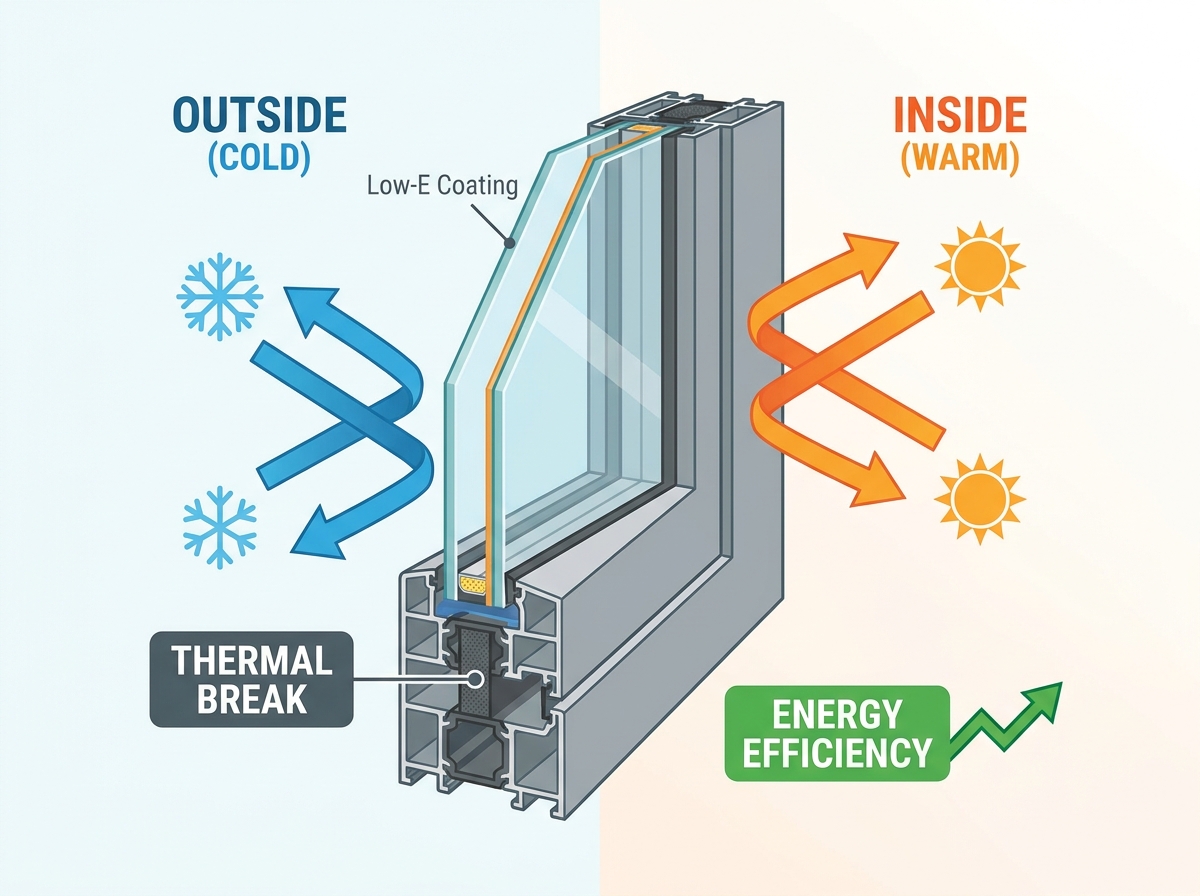
A high-performance frame requires equally high-performance glazing. Installing standard clear glass in a thermally broken frame makes the glass the weak link in the building envelope, negating the frame's benefits. Integrating Low-E glass windows ensures the entire assembly manages solar radiation and thermal retention effectively. You cannot pair a high-tech frame with low-tech glass and expect good field results.
Low-emissivity (Low-E) coatings reflect interior heat back into the room during winter and bounce solar heat away during summer. Specifying soft-coat versus hard-coat Low-E glass depends entirely on climate zones and solar orientation. Soft-coat Low-E offers superior thermal performance and UV protection, ideal for harsh climates. Hard-coat is more durable and allows for higher passive solar heat gain in extremely cold regions.
The standard for modern construction relies on double glazed aluminum windows utilizing argon or krypton gas fills and warm-edge spacers. These components work together to lower the center-of-glass U-factor. Extreme climates or strict Passive House standards often push specifications toward triple glazing.
| Performance Metric | Double Glazed (Thermally Broken) | Triple Glazed (Thermally Broken) |
|---|---|---|
| Thermal Performance (U-Factor) | Excellent baseline compliance for standard energy codes. | Superior insulation, required for Passive House or extreme arctic climates. |
| Weight and Structural Load | Manageable weight; allows for larger single-pane spans. | Significantly heavier; requires robust hardware and limits maximum operable sash size. |
| Acoustic Dampening (STC) | Good reduction of standard urban noise. | Exceptional soundproofing due to multiple glass layers and varying pane thicknesses. |
| Frame Profile Depth | Fits standard slim aluminum extrusions easily. | Often requires a deeper frame extrusion to accommodate the thicker IGU. |
Evaluating the upgrade to triple glazing requires analyzing the weight, structural profile depth, and overall return on investment. In many temperate zones, a well-engineered double glazed unit with premium Low-E coatings and a wide polyamide thermal break provides the optimal balance of performance and structural flexibility.
A common assumption dictates that standard aluminum is sufficient for mild, temperate climates where freezing temperatures are rare. This is a fallacy. Thermal break windows provide critical energy savings and comfort regardless of extreme cold. In temperate zones, the primary challenge is often cooling. A thermally broken frame blocks radiant solar heat gain during hot summer afternoons, reducing air conditioning reliance.
Temperate climates frequently experience significant seasonal temperature swings between day and night. These swings cause morning condensation on standard aluminum frames. A thermal break eliminates this moisture issue, protecting the interior envelope even in moderate weather conditions. We install these in mild coastal areas specifically to stop morning window sweat.
When specifying fenestration, architects must weigh the conceptual trade-offs of various framing materials against project requirements.
Specifying ultra-wide polyamide struts in mild climates represents a significant risk of over-engineering. Pushing for extreme thermal performance where the environment does not demand it results in unnecessary capital expenditure. The energy savings in a temperate zone will never offset the premium required for arctic-level thermal breaks.
To mitigate this, project teams must conduct localized energy modeling. Determine the optimal thermal break width and depth for the specific climate zone. Match the window specification to the actual environmental data rather than defaulting to the highest available rating.
The highest-performing window in the world becomes useless if installed incorrectly. Poor installation compromises the thermal envelope, rendering the high-performance window ineffective due to perimeter air leaks and thermal bridging through metal anchoring systems. I have audited sites where a premium window leaked air because the rough opening flashing was botched.
Custom thermally broken profiles, especially those requiring specific color matching or unique structural shapes, often require extended manufacturing lead times. Failing to account for this can severely delay construction schedules and sequence planning.
Engage manufacturers and glazing contractors during the schematic design phase. Align procurement schedules with construction milestones early in the process. Approving shop drawings and finalizing extrusion profiles months in advance ensures the materials arrive on-site exactly when the framing is ready.
Before finalizing any purchase order for high-performance aluminum fenestration, verify the following technical specifications to ensure compliance and longevity.
A: Yes. The initial investment is offset by significant HVAC equipment downsizing, long-term energy savings, and enhanced indoor comfort. Preventing perimeter condensation eliminates the risk of costly moisture damage to drywall and interior finishes, making them highly cost-effective over the building's lifecycle.
A: Thermally broken systems are highly durable. The polyamide struts and polyurethane pours are engineered to match the structural lifespan of the aluminum frame itself. They typically last 30 to 50 years under normal environmental conditions and proper maintenance.
A: Yes. Double glazed aluminum windows perform exceptionally well in cold climates when paired with a wide thermally broken frame, warm-edge spacers, and climate-appropriate soft-coat Low-E glass. This combination effectively blocks freezing temperatures while capturing winter solar heat.
A: "Thermal break" is the broad engineering concept of separating two conductive materials to stop heat flow. A "thermal strut" refers specifically to the glass-fiber-reinforced polyamide extrusion mechanically inserted between the aluminum profiles to achieve that break.
A: No. Low-E glass only improves the center-of-glass thermal performance. If installed in a standard, non-broken aluminum frame, the metal will still act as a thermal bridge. It will transfer heat and cause perimeter condensation regardless of the glass quality.
A: They do not compromise aesthetics. Modern manufacturing and co-extrusion technologies allow thermally broken frames to maintain the ultra-slim, clean, and minimalist sightlines that architects expect from traditional aluminum framing systems.


