
Views: 0 Author: Site Editor Publish Time: 2026-07-10 Origin: Site


The escalating stringency of global building energy codes, such as ASHRAE 90.1 and passive house standards, places unprecedented performance demands on architectural fenestration. Architects and developers frequently face a trade-off between structural integrity, expansive aesthetic sightlines, and strict thermal performance requirements. Traditional materials often fail to satisfy all three simultaneously. Advancements in fenestration engineering—specifically the integration of structural thermal breaks—have transformed aluminum from a historical thermal liability into a high-performance asset for modern building envelopes. When specified correctly, aluminum doors provide the necessary structural capacity to support heavy glazing while meeting aggressive energy targets.
Overcoming aluminum’s historical reputation as a thermal conductor requires state-of-the-art engineering. Raw aluminum conducts heat at roughly 237 W/(m·K), meaning unbroken frames act as massive thermal bridges. Heat bypasses the insulated glass unit entirely, moving straight through the metal frame. Modern systems address this through structural, glass-fiber reinforced polyamide strips. Polyamide 66 (PA66) reinforced with 25% glass fiber has a thermal conductivity of just 0.3 W/(m·K). These strips mechanically join the interior and exterior aluminum profiles, effectively interrupting the heat transfer path while maintaining the structural rigidity required for heavy wind loads.
The manufacturing process for these thermally broken frames is highly precise. It involves several distinct mechanical steps to ensure the frame can withstand both dead loads from the glass and dynamic loads from wind and building movement.
Utilizing the high strength-to-weight ratio of modern aluminum doors allows structural engineers to support large-format glazing, including heavy triple-pane insulated glass units (IGUs). This capability enhances natural daylight harvesting while maintaining low U-factors. Slim sightlines allow architects to achieve minimalist, contemporary designs without compromising structural or thermal boundaries. On the job site, these rigid frames resist racking and twisting during installation, ensuring the weatherstripping and multi-point locks align perfectly once the building settles.
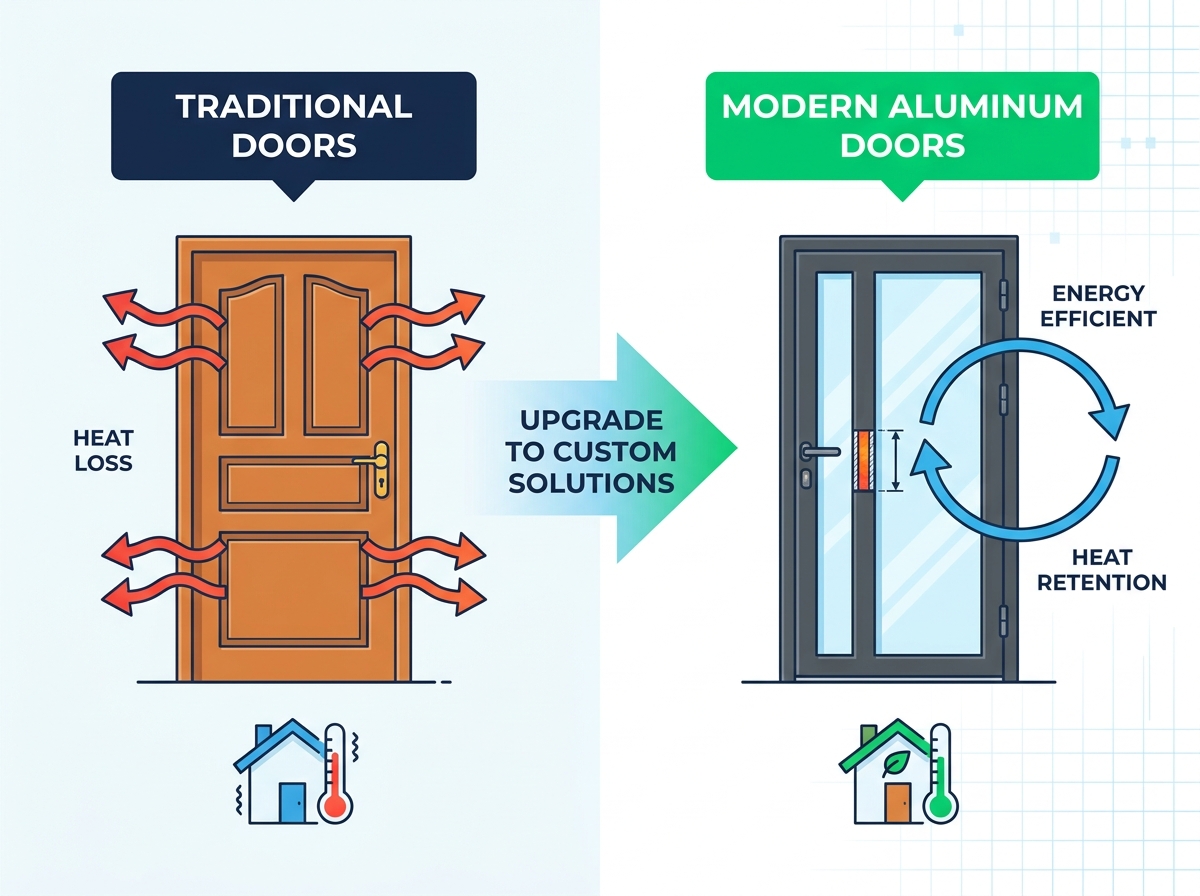
Industry data demonstrates significant energy savings on HVAC loads when utilizing high-performance thermal break systems. Proper specification of exterior aluminum doors controls heat loss (U-factor) and solar heat gain (SHGC) to stabilize indoor microclimates. This stabilization directly impacts long-term financial performance by decreasing utility bills and reducing mechanical equipment sizing requirements through superior envelope airtightness. When performing Manual J calculations for HVAC sizing, the improved U-factor of thermally broken frames allows engineers to specify smaller, more efficient heating and cooling plants.
Furthermore, high-performance frames mitigate surface condensation. The Condensation Resistance Factor (CRF) measures a frame's ability to resist moisture formation on the interior surface when outside temperatures drop. Preventing condensation stops mold growth, protecting indoor air quality and the structural integrity of surrounding finishes like drywall returns and wood casings. In northern climate zones, a low CRF leads to frost buildup on the interior frame, which eventually melts and damages the flooring below.
To understand the impact of thermal breaks and glazing choices, specifiers rely on NFRC-certified testing data. The overall assembly U-factor is a combination of the center-of-glass, edge-of-glass, and frame U-factors.
| Frame Type | Glazing Type | Spacer Type | Estimated Assembly U-Factor |
|---|---|---|---|
| Standard Aluminum (Unbroken) | Double Pane Clear | Aluminum Box Spacer | 0.70 - 0.85 |
| Thermally Broken Aluminum (Standard) | Double Pane Low-E (Argon) | Warm Edge Spacer | 0.35 - 0.45 |
| Thermally Broken Aluminum (Wide Strut) | Triple Pane Low-E (Argon) | Warm Edge Spacer | 0.25 - 0.30 |
| Thermally Broken Aluminum (Foam Filled) | Triple Pane Low-E (Krypton) | Non-Metallic Warm Edge | 0.18 - 0.22 |
Aluminum inherently resists warping, cracking, rust, and degradation, making it ideal for extreme climates, including coastal, high-humidity, and urban environments. Unlike wood, which requires constant sealing to prevent rot, or vinyl, which can become brittle and warp under high UV exposure, aluminum maintains its structural integrity over decades. Manufacturers engineer custom aluminum doors to meet precise architectural dimensions, configurations, and finishes. High-performance coatings, such as AAMA 2605 fluoropolymer (PVDF) paints and Class I anodizing, provide exceptional resistance to chalking, fading, and salt spray corrosion.
Beyond thermal performance, multi-cavity profiles and heavy-duty seals provide superior sound dampening. This acoustic insulation is essential for urban and commercial applications near highways or airports. Sound Transmission Class (STC) and Outdoor-Indoor Transmission Class (OITC) ratings improve significantly when thermally broken frames are paired with asymmetrical laminated glass. The varying glass thicknesses break different sound wave frequencies, while the polyamide strut disrupts vibration transfer through the frame.
Modern systems also integrate heavy-duty hardware to ensure effortless operation and high-security performance over the building's lifespan. The integration of a European groove (Eurogroove) allows for standardized, highly secure hardware components.
Selecting the correct fenestration requires balancing structural wind-load requirements with target energy ratings. Structural engineers calculate the required moment of inertia for the frame mullions based on local wind loads and the building's height. The standard deflection limit for commercial framing is typically L/175, meaning the frame cannot bow more than the length of the span divided by 175 under peak wind pressure. When comparing core materials, thermal-break aluminum often outperforms steel, wood, and uPVC in commercial and high-end residential applications due to its structural stability and minimal maintenance requirements.
Specifiers must also verify sustainability certifications. Checking Environmental Product Declarations (EPDs), recycled content ratios, and contributions to LEED v4.1 points ensures the selected systems align with the project's broader environmental goals. Aluminum is infinitely recyclable, and many extruders use a high percentage of pre-consumer and post-consumer recycled billet, significantly reducing the embodied carbon of the building envelope.
| Material | Structural Strength | Thermal Expansion Rate | Maintenance Level | Aesthetic Flexibility |
|---|---|---|---|---|
| Thermal-Break Aluminum | High (Meets L/175 easily) | Low | Low | Very High (Narrow sightlines) |
| Wood | Moderate | Low | High (Requires painting/sealing) | High (Traditional profiles) |
| uPVC (Vinyl) | Low (Requires steel reinforcement) | High (Prone to warping) | Low | Low (Thick sightlines) |
| Fiberglass | High | Very Low | Low | Moderate |
Modern aluminum fenestration bridges the gap between high-performance thermal metrics, structural resilience, and design flexibility. Investing in premium thermal-break aluminum systems future-proofs building assets against evolving energy regulations while providing long-lasting operational reliability. To ensure successful implementation on your next project, follow these field-tested steps:
A: A thermal break is a non-conductive material, typically a glass-fiber reinforced polyamide strip, inserted between the interior and exterior aluminum profiles. It physically separates the metal extrusions, stopping the transfer of heat or cold through the frame and significantly improving energy efficiency.
A: Energy efficiency is measured using the U-factor (rate of heat loss), Solar Heat Gain Coefficient (SHGC), and Visible Transmittance (VT). Lower U-factors indicate better insulation. These metrics are tested and certified by the National Fenestration Rating Council (NFRC).
A: Yes. Thermally broken aluminum frames possess a high strength-to-weight ratio, allowing them to easily support the heavy dead loads of triple-pane insulated glass units without sagging or requiring excessively thick sightlines.
A: The standard deflection limit is typically L/175 for spans under 13 feet, meaning the frame will not bow more than the total length divided by 175 under maximum design wind loads. This prevents the glass from breaking under pressure.
A: Condensation Resistance Factor (CRF) measures how well a frame prevents interior surface moisture. Thermal breaks keep the interior aluminum profile closer to room temperature, preventing warm, moist indoor air from condensing on cold metal surfaces.
A: Aluminum requires minimal maintenance. Routine cleaning with mild soap and water to remove dirt and salt deposits, along with occasional lubrication of the hinges and locking hardware, will keep the system operating smoothly for decades.


