
Views: 0 Author: Site Editor Publish Time: 2026-08-04 Origin: Site


Sourcing 100+ window units for commercial developments or large-scale residential projects involves significant logistical stakes. The tension between minimizing unit costs, maintaining strict architectural specifications, and ensuring reliable delivery timelines defines the procurement process. Choosing the right supply chain partner dictates project momentum and site efficiency. This article introduces a structured evaluation framework to determine whether partnering directly with an overseas factory or utilizing a local fabricator yields the best return on investment and lowest project risk. Understanding the capabilities and limitations of each option is necessary for successful bulk procurement. We break down the operational realities of both routes. You will see exactly how to manage lead times, verify material specs, and handle site logistics. The goal is to align your procurement strategy with your construction schedule and architectural requirements.
Large-scale facilities operate massive extrusion presses, ranging from 600-ton to 3000-ton capacities, to push raw aluminum billets through custom steel dies. After extrusion, the profiles go through aging ovens to achieve the required T5 or T6 temper for structural rigidity. These facilities then apply surface treatments. Vertical powder coating lines or anodizing baths provide the architectural finish. Once the profiles are treated, they move to the thermal break insertion lines where polyamide strips are rolled into the aluminum to prevent thermal bridging. Finally, the profiles reach the CNC machining centers and assembly lines. Here, workers cut, mill, and crimp the frames before installing the glazing and hardware. They offer high-volume output, deep customization, and direct production of proprietary architectural designs. Developers, large contractors, and trading companies requiring container-volume shipments typically target a direct aluminum windows factory to bypass regional markups.
Working with a primary manufacturer means you are dealing with the source of the material. You control the extrusion dies, the paint codes, and the glass specifications. This level of control requires your team to provide flawless shop drawings. The factory builds exactly what is on the approved CAD files. If the rough opening dimensions on your job site vary from the architectural plans, factory-direct units will not fit without site modifications. You must enforce strict framing tolerances on your framing crews when ordering direct.
Regional businesses operate differently. They do not extrude aluminum or paint profiles. Instead, they purchase pre-designed, pre-painted aluminum profiles in standard lengths (usually 20 to 24 feet) from system companies. The local shop receives these extrusions, cuts them to size using double miter saws, routes the hardware slots, and assembles the final windows locally. They provide fast turnaround, regional compliance expertise, and localized installation support. Custom home builders, renovation contractors, and projects requiring phased, just-in-time delivery rely on local fabricators.
The local fabricator adds value through agility. If a framer makes a mistake and a rough opening is two inches too wide, the local shop can adjust the cut list for that specific window before assembly. They also handle the glazing locally, sourcing insulated glass units (IGUs) from regional glass plants. This reduces the risk of glass breakage during long-haul transit. However, this localized labor and fragmented supply chain increase the per-unit cost significantly.
System companies own the intellectual property for profile aesthetics and performance characteristics. They engineer the thermal breaks, gasket designs, and hardware grooves. They test the systems for wind load and water penetration. However, they do not fabricate final units. They sell the extrusions and hardware to local fabricators. Trading companies operate in a completely different manner. They often act as middlemen posing as a direct aluminum window manufacturer. Spotting them during the procurement phase helps avoid unnecessary markups. You can identify a trading company by asking for live video tours of their extrusion presses. If they only show an assembly room or refuse a video call, they are likely a broker adding a margin to another factory's product.
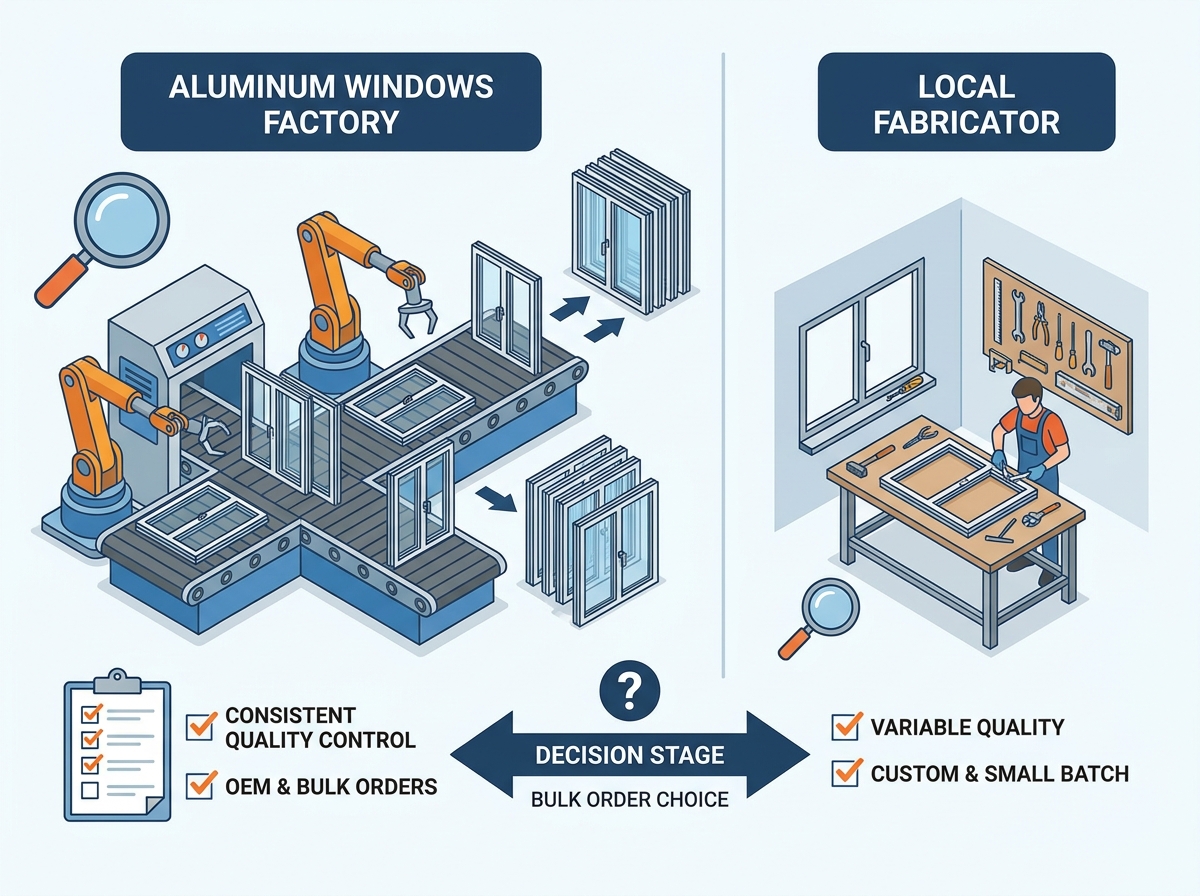
Direct sourcing eliminates middleman markups and local assembly labor costs. When you order 500 windows directly from the source, the factory optimizes its cutting yield, reducing aluminum scrap. Minimum Order Quantities impact pricing tiers significantly. Most factories require at least one 20-foot container to justify the production run. Upfront investments for custom extrusion dies are required when ordering non-standard profiles. However, die costs for aluminum are relatively low compared to plastic injection molding. A custom window mullion die might cost a few hundred dollars, which is easily absorbed in a large commercial order.
To understand the financial mechanics, you must look at the bill of materials. Aluminum is traded as a global commodity. The factory bases its quote on the current aluminum ingot price plus a processing fee for extrusion, painting, and assembly. By cutting out the local fabricator, you avoid paying regional labor rates for assembly, which often exceed the cost of the materials themselves in high-cost urban markets.
You cannot simply compare the factory's FOB (Free On Board) unit price to a local fabricator's delivered price. Logistics include ocean freight, import duties, customs clearance, and port handling fees. Drayage—the cost of trucking the container from the port to your job site—can be substantial. Warehousing bulk container deliveries adds costs if the construction site is not ready for immediate installation. You must factor in chassis rental fees if the container sits on a trailer for weeks.
Budgeting for potential delays is necessary. Ocean freight can face port strikes, customs holds, or weather delays. You also need a contingency fund for replacing units damaged in international transit. If a forklift punctures a crate at the port, you cannot wait eight weeks for a replacement from overseas. You will likely have to pay a local shop a premium to fabricate a matching replacement unit quickly.
| Cost Factor | Direct Factory Sourcing | Local Fabricator Sourcing |
|---|---|---|
| Unit Material Cost | Low (Commodity pricing) | High (Includes system company markup) |
| Assembly Labor | Low (Overseas rates) | High (Regional rates) |
| Ocean Freight & Duties | High (Requires container shipping) | None (Locally sourced) |
| Site Storage & Staging | High (Bulk delivery requires space) | Low (Just-in-time delivery possible) |
| Custom Tooling (Dies) | Low (Factory absorbs or charges minimal fee) | High (Requires custom order from system house) |
Evaluating the feasibility of importing raw, extruded profiles from an overseas factory and paying a local fabricator for assembly and glazing can mitigate import risks while controlling costs. In this model, you buy the painted aluminum sticks and hardware in bulk. You ship them in a container, which holds significantly more linear footage of raw profiles than fully assembled windows. The local shop then cuts and glazes the units. This hybrid approach leverages cheap overseas aluminum extrusion while maintaining local control over assembly tolerances and glass sourcing.
Conduct virtual showroom tours and live video audits of the extrusion lines and CNC assembly areas. Assess the facility based on ISO certifications, automated assembly precision, and documented testing protocols. Verify factory-level water penetration, wind load resistance, and thermal break efficiency tests. Hiring independent inspectors to verify window quality control before container loading is mandatory. These third-party engineers visit the factory, pull random units from the production line, and check the diagonal measurements to ensure the frames are perfectly square.
Inspectors also verify the paint thickness using digital gauges. For commercial projects, the powder coating must meet specific architectural standards, such as AAMA 2604 or 2605, to resist fading and chalking under UV exposure. They check the EPDM gaskets for proper compression and ensure the corner cleats are heavily sealed with structural silicone to prevent water intrusion. You must demand a comprehensive inspection report with photographic evidence before authorizing the final balance payment and allowing the container to be sealed.
Hand-assembly allows rectifying defects immediately on the shop floor. If a local worker notices a scratch on a profile, they simply grab another length from the rack. Local fabricators navigate local building codes, energy efficiency mandates, and secure necessary regional certifications. They understand the specific egress requirements for residential bedrooms in your municipality. They know exactly which Low-E glass coatings are required to pass your local energy code inspections.
Local shops also provide immediate accountability. If a window leaks after installation, the fabricator sends a technician to the site the next day to adjust the hinges or replace the weatherstripping. This level of rapid response is impossible when dealing with an overseas supplier, making local sourcing highly attractive for projects with strict handover deadlines and zero tolerance for punch-list delays.
Direct factories execute proprietary architectural designs, custom glass configurations, and specialized hardware integration for OEM aluminum windows. If your architect designs a unique curtain wall mullion with a specific exterior fin, the factory cuts a new die and extrudes it. Assess whether the manufacturer supports Building Information Modeling (BIM), advanced CAD modeling, and structural wind-load calculations. They should provide detailed shop drawings showing every screw, weep hole, and thermal break.
Mitigate risks of misinterpretation in technical drawings across language barriers. Do not rely on text descriptions. Use detailed cross-sectional CAD drawings with clear dimensional callouts. Specify the exact brand and model of hardware you want, such as Hoppe handles or Siegenia friction stays. If you leave hardware specifications vague, the factory will use standard domestic components, which may not meet your operational lifespan expectations.
Local fabricators rely on standard profile catalogs dictated by upstream system suppliers. If the system company does not offer a specific sightline or frame depth, the local shop cannot magically create it. You are constrained by their existing inventory and catalog options. However, fast physical mock-up approvals allow rapid design adjustments before full production runs. You can drive to the local shop, look at a corner sample, test the handle operation, and approve the finish in person.
This agility extends to the construction site. If the architect decides to change the window operation from a casement to an awning on the top floor, the local fabricator can usually accommodate the change order within a week, provided they have the profiles in stock. An overseas factory would require a completely new production run and another six weeks of shipping.
Factor in factory production queues of 4–8 weeks plus international ocean freight of 4–6 weeks. You must also account for customs clearance, which can take anywhere from three days to two weeks depending on port congestion and random inspections. Coordinate multiple container shipments to align with specific construction phases. Do not ship all the windows for a 10-story building in one massive batch unless you have a secure, dry warehouse to store them.
Site logistics require careful planning. When a 40-foot High Cube container arrives at your job site, you usually have two hours of free unloading time before the trucking company starts charging demurrage fees. You need a dedicated crew, a forklift with extended forks, and a clear staging area to unload heavy wooden crates safely.
Just-in-Time delivery reduces site storage requirements by receiving windows exactly when needed. The local shop can deliver the first-floor windows on Monday, the second-floor windows on Wednesday, and so on. This eliminates the need for on-site storage containers and reduces the risk of theft or damage from other trades working around stacked window units.
Local fabricators quickly manufacture replacement units for windows mismeasured or damaged on-site. If a drywall lift crashes into a sliding door, the local shop can cut a new frame and glaze it within 48 hours. This speed keeps your project on schedule and prevents minor accidents from causing major delays in obtaining the certificate of occupancy.
Processing claims, returning defective units, or sourcing replacement hardware from an overseas supplier presents logistical difficulties. You cannot ship a broken window back across the ocean. You must negotiate warranty terms upfront. Require the factory to include a percentage of spare parts—extra handles, hinges, gaskets, and touch-up paint—inside the initial container. If a major failure occurs, the factory should agree to ship replacement parts via express air freight at their expense.
Local fabricators offer on-site troubleshooting, accessible replacement parts, and labor warranties. If an insulated glass unit fails and fogs up after two years, the local shop sends a crew to deglaze the sash and install a new IGU. This local labor warranty provides peace of mind for developers who hold the property long-term and want to avoid maintenance headaches.
Evaluate export packaging protocols to prevent glass breakage and profile scratching. Standard cardboard boxes are unacceptable for ocean freight. Demand reinforced plywood crates with internal steel bracing. The windows must be separated by thick foam pads, wrapped in protective film, and secured with heavy-duty strapping. Desiccant packs must be placed inside the crates to absorb moisture and prevent the aluminum from oxidizing in the humid sea air.
Determine liability using Incoterms during shipping and ensure adequate freight insurance. Do not buy on FOB terms unless you have an experienced freight forwarder. CIF (Cost, Insurance, and Freight) or DDP (Delivered Duty Paid) terms shift more responsibility to the supplier. Always purchase comprehensive marine cargo insurance that covers the full replacement value of the goods, plus the cost of expedited shipping for replacement units.
Direct factories are the optimal choice for high-volume, standardized, or highly custom OEM projects with flexible lead times and dedicated logistics management. Local fabricators are superior for fast-track, complex-phased, or smaller-scale projects requiring high agility. Base the decision on a strict calculation of Total Landed Cost versus project timeline constraints. You must weigh the upfront savings against the logistical burden of managing international freight and site staging.
Take these steps to finalize your procurement strategy:
A: MOQs for direct factories typically start around 100 to 200 square meters or a 20-foot container. This volume justifies the setup time on the extrusion and assembly lines. Custom profiles requiring new dies may have higher MOQs.
A: Hire independent third-party inspection agencies to conduct pre-shipment inspections. They visit the factory, verify material specifications, check frame squareness, measure paint thickness, and perform physical testing on random samples before the container is loaded.
A: Yes, for large volumes, sourcing custom designs directly from a factory often costs less per unit than purchasing standard profiles locally. The savings on regional labor and middleman markups offset the initial tooling and shipping costs.
A: A manufacturer extrudes the raw aluminum billets, applies the surface finishes, and produces the materials at scale. A fabricator buys these pre-extruded, pre-painted profiles and cuts, crimps, and glazes them into finished windows locally.
A: Request live video tours of the production floor specifically showing the heavy extrusion presses and powder coating lines. Check their business licenses for manufacturing scope, and ask highly technical questions about extrusion dies and thermal break insertion.
A: Negotiate terms upfront for replacement parts to be shipped via air freight at the factory's expense. Always order extra spare parts, such as handles, friction stays, and gaskets, to be included with the initial container shipment for immediate on-site repairs.


