
Views: 0 Author: Site Editor Publish Time: 2026-07-28 Origin: Site


Sourcing fenestration for commercial builds, multi-family developments, or high-end residential projects requires balancing strict budgets against uncompromising architectural specifications. Buyers must decide whether to absorb the logistical complexity of buying direct from an aluminum window supplier to protect margins, or pay a premium to a local distributor for convenience and localized risk mitigation. The wrong choice leads to project delays, compromised building envelopes, or blown budgets. This guide provides an evidence-based framework for evaluating both sourcing models. We analyze the trade-offs between cost, lead times, customization, and compliance to determine the most viable procurement strategy for your specific project scale in 2026 and beyond. By understanding the operational realities of both direct manufacturing facilities and regional warehousing, procurement teams can align their purchasing strategy with actual site demands.
Understanding the fundamental differences between the source of manufacturing and the point of distribution clarifies where risks and responsibilities lie in the supply chain. Procurement teams must map out the exact origin of their fenestration packages to anticipate logistical hurdles before the foundation is even poured.
Purchasing directly from the manufacturing facility means you are dealing with the entity cutting the extrusions, assembling the thermal breaks, and glazing the units. This model removes intermediaries. Domestic manufacturers operate within your country's borders, while a window export supplier operates overseas, shipping containers globally across major ocean freight lanes.
The supplier ecosystem is split between system developers and independent fabricators. System developers design proprietary profile systems and test them rigorously in controlled laboratory environments. Independent fabricators buy these raw profiles and assemble them according to the developer's manual. The typical buyer profile for direct sourcing includes developers, large-scale general contractors, and specialized architectural firms managing projects with enough volume to fill multiple shipping containers. These buyers have the internal infrastructure to handle complex supply chain management.
Local distributors act as regional middlemen. They purchase in bulk from various manufacturers, import the goods, and warehouse inventory locally. They handle the logistics of getting the product from the factory floor to a regional hub, absorbing the headache of port delays and customs clearance. The typical buyer profile includes custom home builders, remodelers, and mid-sized contractors who require phased deliveries and cannot accommodate massive container drops on site. These buyers prioritize immediate availability and local support over absolute cost reduction.
Before selecting a sourcing model, evaluate the specific constraints and requirements of your build. Every construction site has unique limitations regarding staging areas, hoisting capabilities, and schedule flexibility.
Procurement teams must calculate the break-even point where the overhead of direct sourcing is justified by unit cost reductions. Ordering a handful of units directly from a factory rarely makes sense due to high freight minimums and administrative overhead. High-volume projects absorb these logistical overheads, making direct purchasing highly advantageous. You must weigh the internal cost of managing the procurement against the hard savings on the materials.
Mapping procurement timelines accurately prevents site standstills. Direct manufacturing often takes 12 to 16 weeks, factoring in production queues, ocean freight, and customs clearance. Local distribution can fulfill orders in 2 to 6 weeks from existing stock. If the framing is already going up, direct sourcing is likely off the table unless planned months in advance. Site superintendents need realistic delivery dates to schedule rough carpentry and weatherproofing trades.
Assess the need for bespoke extrusions, specific glazing packages, or unique anodized finishes. Off-the-shelf solutions from distributors work well for standard openings and conventional designs. Complex architectural designs demand direct engagement with a manufacturer capable of engineering custom solutions. When architects specify narrow sightlines or oversized operable vents, standard distributor stock usually falls short.
Aluminum presents inherent challenges like thermal bridging and condensation risks. Sourced products must meet local standards for wind load, water penetration, and thermal transmittance. Coastal environments require specific marine-grade finishes to prevent corrosion from salt spray. Ensuring compliance is critical regardless of where the windows originate. Failing a building inspection due to non-compliant fenestration will halt a project indefinitely.
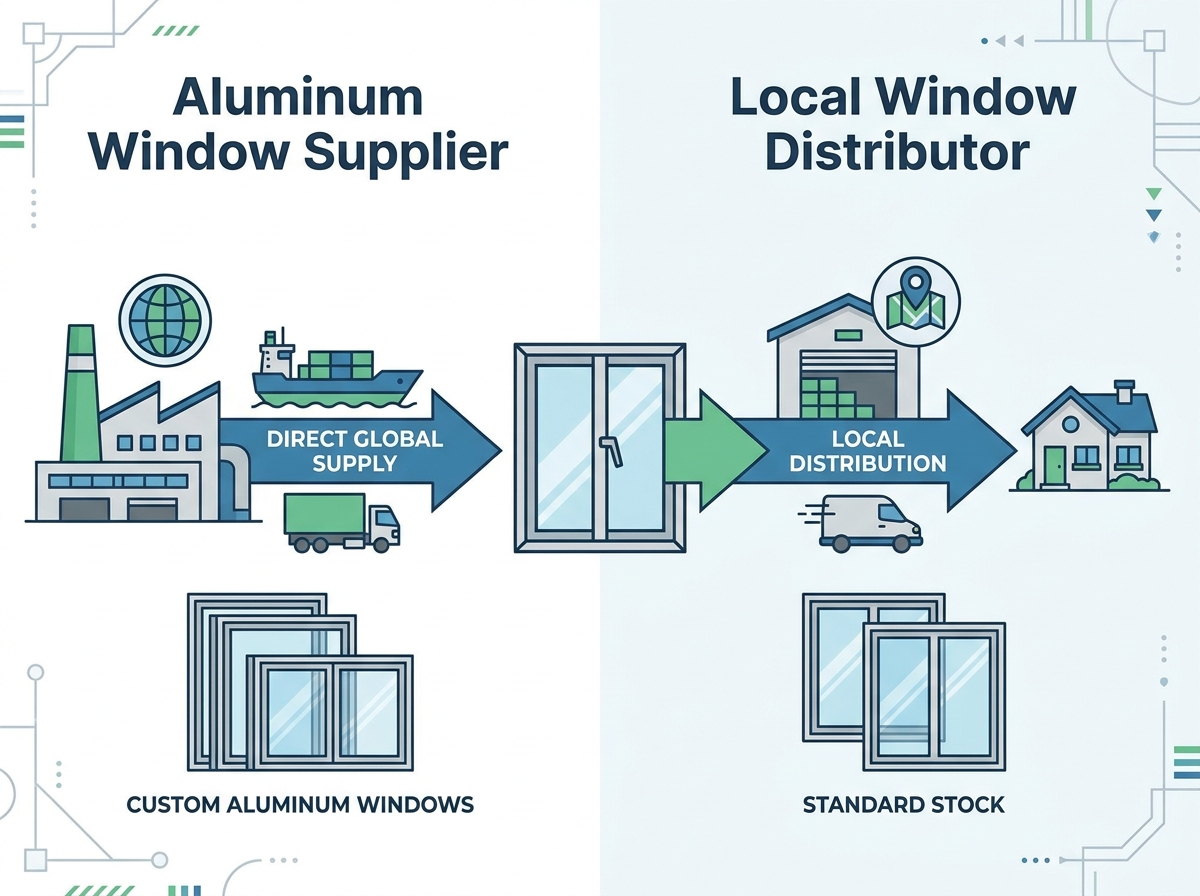
Engaging directly with an aluminum windows supplier offers distinct benefits but introduces complex logistical responsibilities that your team must be prepared to handle.
Bypassing distributor markups impacts the bottom line significantly on high-volume orders. When purchasing hundreds of units, the unit cost reduction outweighs the expenses associated with freight and import management. This efficiency allows developers to allocate funds to other critical areas of the build, such as upgraded interior finishes or advanced HVAC systems. The savings scale linearly with the size of the order.
Direct engagement provides the ability to dictate exact profile dimensions, thermal break technologies, glass thicknesses, and custom color matching without middleman restrictions. You can integrate high-performance architectural details like European-style tilt-and-turn hardware and multi-chamber polyamide thermal breaks. Custom aluminum windows elevate the aesthetic and functional value of a property, allowing architects to execute their vision without compromise.
The hidden costs of direct sourcing include container shipping rates, customs brokerage, import duties, and port delays. Managing these elements requires dedicated procurement personnel or specialized logistics partners. Port congestion can derail project schedules unexpectedly. You must factor in demurrage charges if containers sit at the port longer than anticipated due to missing paperwork or trucking shortages.
The necessity of third-party factory audits and pre-shipment inspections cannot be overstated. Managing damaged goods without a local representative is challenging. Buyers must enforce rigorous quality control protocols before containers leave the factory floor. Implementing a strict inspection checklist ensures that what arrives on site matches the approved shop drawings.
Distributors provide convenience and localized support, which is invaluable for certain project types where speed and flexibility outweigh raw material cost savings.
Having a local partner warehouse units and deliver them to the job site exactly when the framing is ready offers immense value. Phased deliveries prevent site clutter and reduce the risk of on-site damage before installation. Urban job sites with zero lot lines simply cannot accommodate a 40-foot shipping container, making local, just-in-time delivery a necessity.
Local distributors act as a buffer for warranty claims, replacement parts, and on-site troubleshooting. If a unit fails or arrives with cracked glazing, the distributor handles the replacement process rapidly, keeping the project moving. You have a local representative to call who can visit the site, assess the issue, and pull replacement parts from their warehouse.
Locally distributed products generally possess the necessary regional certifications for energy efficiency and structural integrity. Distributors stock items engineered for the specific climate zone they serve, reducing compliance headaches for the builder. They already have the NFRC labels and structural test reports formatted for your local building department.
Distributor margins impact the overall budget. You pay for the convenience of warehousing, local support, and immediate availability. Furthermore, distributors offer limited flexibility regarding deep customization, restricting architectural freedom. If you need a custom extrusion die or a non-standard powder coat color, the distributor will likely have to go back to the manufacturer anyway, negating their speed advantage.
Comparing the two models requires looking at performance, durability, and long-term maintenance to ensure the building envelope performs as designed for decades.
Evaluate how both models provide proof of performance to meet evolving energy codes. Direct-import products carry the risk of failing local inspections if uncertified. Distributors usually provide pre-certified units. Always demand independent testing reports for U-factor and Solar Heat Gain Coefficient. The glazing package must be simulated in conjunction with the specific aluminum frame to provide an accurate overall thermal rating.
Evaluate anodizing options versus organic coatings and their performance in harsh coastal environments. Direct suppliers often provide a wider range of custom finishes, but you must specify the exact micron thickness required for durability. AAMA 2605 powder coatings offer superior UV resistance, while Class I anodizing provides excellent scratch resistance. Specify the finish based on the building's exposure and maintenance schedule.
Consider the ease of procuring replacement hardware, weatherstripping, or replacement glazing units years post-installation. Distributors often stock common replacement parts. Direct suppliers may require international shipping for a single broken handle. Building owners need a clear maintenance manual and a reliable source for proprietary gaskets and locking mechanisms to keep the windows operational over a 30-year lifespan.
| Evaluation Criteria | Direct Manufacturer Sourcing | Local Distributor Sourcing |
|---|---|---|
| Production & Delivery Lead Time | 12 to 16 Weeks (Includes Ocean Freight) | 2 to 6 Weeks (From Local Stock) |
| Architectural Customization | High (Custom dies, bespoke finishes) | Low to Medium (Standard catalogs) |
| Site Logistics Burden | High (Buyer manages containers and staging) | Low (Distributor manages phased delivery) |
| Warranty & Parts Support | Remote (Factory direct, international shipping) | Local (On-site visits, regional warehouse) |
| Code Compliance Verification | Buyer Responsibility (Requires 3rd party testing) | Distributor Responsibility (Pre-certified) |
If direct sourcing aligns with your project, rigorous vetting is mandatory to mitigate risks. You cannot rely on a polished website; you need hard data on their manufacturing capabilities and quality control processes.
Verify facility size, automated machinery, and monthly output capacity. Look for CNC cutting lines and automated glazing equipment. A supplier must demonstrate the ability to handle your order volume without compromising quality or delaying other shipments. Request videos of their production floor or hire a local proxy to conduct a physical site visit.
Assess how the supplier handles the shop drawing phase, CAD modeling integration, and structural wind-load calculation reviews. Strong engineering support ensures the manufactured units will perform as specified under actual site conditions. The supplier should provide detailed section details showing thermal breaks, weep hole locations, and installation anchor points.
Ensure the supplier has a track record of exporting to your specific country and holds recognized testing reports. Experience with international shipping protocols and packaging standards prevents transit damage. Ask for references from previous clients in your region and verify that their products successfully passed local building inspections.
Negotiate Incoterms clearly to define where liability transfers. Establish payment schedules tied to production milestones and bill of lading issuance. Define warranty stipulations explicitly, including how replacement parts will be handled and shipped in the event of defects. Ensure the contract specifies the exact hardware brands, glass processors, and powder coating standards to be used.
A: MOQs vary significantly. Overseas suppliers typically require a minimum of a 20ft shipping container to make freight viable. Domestic direct suppliers may base their MOQs on total project volume or a specific unit count, depending on their production setup.
A: Custom dimensions carry a premium due to engineering and setup time. However, buying custom sizes directly from a manufacturer is often more economical than purchasing standard sizes through a heavily marked-up local distributor.
A: Raw aluminum is vulnerable to saltwater corrosion. Premium custom aluminum windows coated with marine-grade finishes, such as Seaside-class powder coatings or thick Class I anodized finishes, offer exceptional durability in coastal areas.
A: You must request independent, third-party testing certificates for thermal and structural performance before placing an order. Verify these documents with your local building inspector or architect to ensure compliance.
A: Historically, aluminum suffered from poor insulation and condensation. Modern systems use multi-chamber polyamide thermal breaks and low-E glazing to mitigate these factors, though they still require careful specification to meet strict energy codes.
A: The buyer must deal directly with the factory. This may involve shipping replacement parts internationally, highlighting a key risk compared to local distributors who handle claims regionally.
A: Realistic timelines are 4 to 8 weeks for production. If importing, add an additional 4 to 6 weeks for ocean freight and customs clearance, making the total lead time 8 to 14 weeks.


