
Views: 0 Author: Site Editor Publish Time: 2026-07-27 Origin: Site


Procuring fenestration for multi-residential, commercial, or large-scale development projects represents a critical line item where supply chain inefficiencies directly erode profit margins. Buyers must choose between sourcing directly from a primary supplier, contracting with an overseas trading company, or utilizing a local fabricator. Misaligning the project scope with the wrong supplier type leads to budget overruns, inconsistent quality across batches, or catastrophic lead-time failures. This guide provides a technical evaluation framework to determine whether a direct factory, a middleman broker, or a regional fabricator is the optimal procurement route based on volume, customization requirements, structural performance, and risk tolerance. We will examine the operational realities of each supply chain node to help you align your procurement strategy with actual site demands.
A vertically integrated facility handles the complete production lifecycle from raw billet to finished unit. This includes aluminum extrusion, thermal break insertion, surface finishing, glass integration, and final assembly. When you work with a primary aluminum window manufacturer, you gain direct access to the source of production. These facilities engineer and produce structural systems to precise architectural specifications. They build their operations for high-volume output, standardized quality control, and direct-to-developer sales. The factory floor typically houses massive extrusion presses, automated anodizing lines, and CNC machining centers that process thousands of linear feet of profile daily. This scale allows them to absorb the upfront engineering costs of custom dies and specialized thermal modeling.
Direct manufacturers also maintain in-house testing laboratories. They conduct daily batch testing for corner joint strength, powder coat adhesion, and thermal break shear strength. This vertical integration means they control the entire material timeline. If a specific architectural bronze anodized finish is required, they do not wait on a third-party finisher. They process it internally, ensuring color consistency across massive elevations. For high-rise developments requiring unitized curtain walls or heavy commercial ribbon windows, this level of control prevents the cascading delays common in fragmented supply chains.
A local fabricator runs an assembly operation rather than a primary production facility. They purchase pre-manufactured aluminum profiles, hardware, and glazing from larger system suppliers under license. Their core capability involves cutting, joining, and assembling standard catalog systems to fit local project dimensions. Fabricators focus on regional distribution and shorter local lead times. They serve low-to-mid volume residential or light commercial projects effectively. A typical fabricator operates out of a regional industrial park, utilizing double-miter saws, copy routers, and corner crimping machines to assemble pre-finished extrusions.
Because they buy profiles in standard lengths (usually 24 feet) and cut them down, fabricators generate scrap that factors into their unit costs. They rely entirely on the engineering and testing provided by their system supplier. If a project requires a deeper mullion to meet a specific wind load, the fabricator must check if the supplier's catalog includes that specific profile. If it does not, the fabricator cannot simply extrude a new one. They must either reinforce an existing profile with steel inserts or pass on the job. However, their proximity to the job site allows them to take field measurements after rough openings are framed, accommodating construction variances that a distant factory cannot.
Sourcing brokers and trading companies are intermediary entities that complicate the procurement landscape. They market themselves as factories but outsource actual production to third-party facilities. These entities offer short-term convenience and multi-product bundling, often pitching everything from fenestration to flooring in a single container. However, they lack direct quality control over the manufacturing process. They inflate unit costs for bulk orders and complicate technical support. Relying on a broker introduces unnecessary risk into large-scale construction schedules.
Trading companies rarely employ structural engineers or facade specialists. When you submit architectural drawings to a broker, they forward them to a shadow factory. Any technical clarifications must pass through this intermediary, leading to miscommunications regarding thermal break alignments, glazing bead profiles, or hardware prep. Furthermore, if a batch of windows arrives on site with defective weatherstripping or scratched glass, the trading company has little leverage to force the actual factory to expedite replacements. They simply act as a tollbooth on your supply chain.
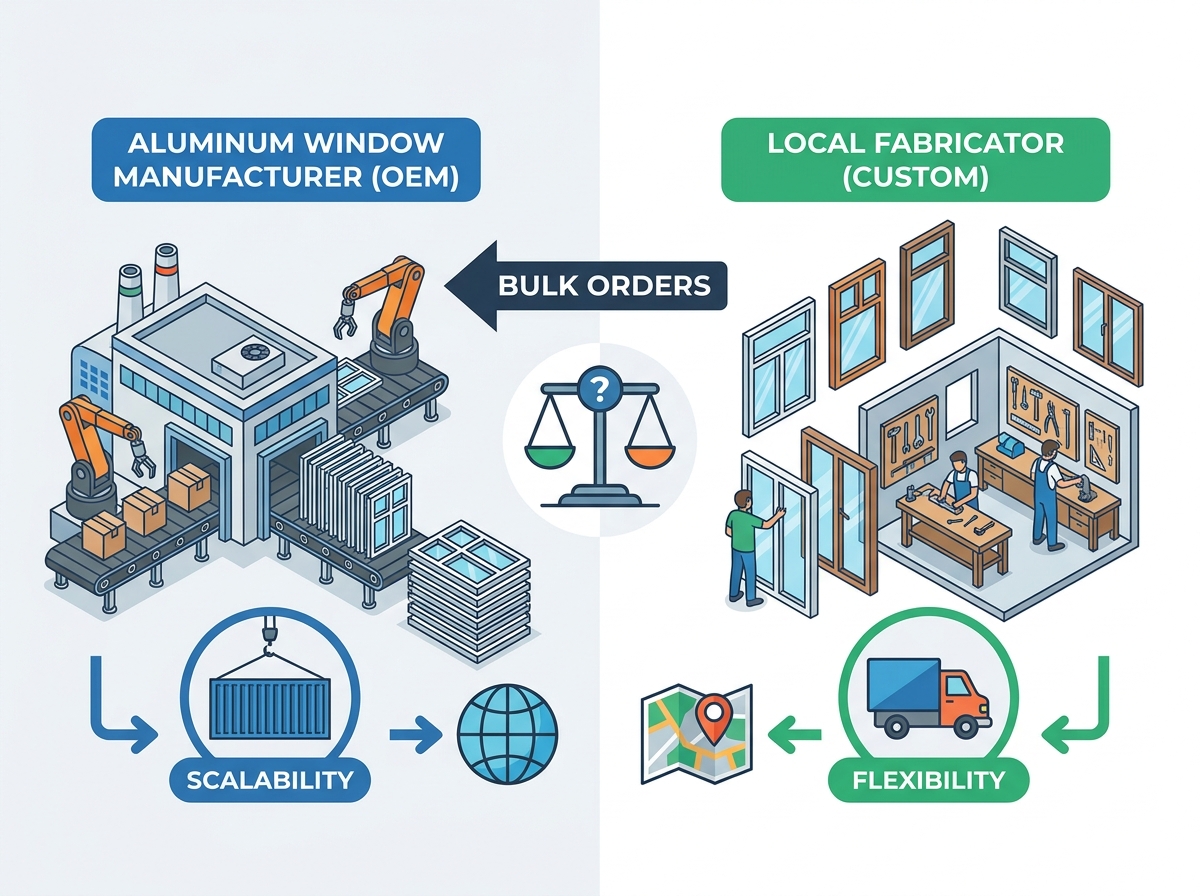
New construction and high-rise developments demand high structural strength. They require strict wind-load resistance and uniform aesthetics across large curtain walls. These requirements make them highly suited for direct manufacturers. The structural demands of a 30-story building require heavy-wall extrusions and engineered anchor systems that exceed the capabilities of standard fabricator catalogs. Adaptive reuse and historic restoration projects require replica profiles. You often need customized sightlines to match historical preservation codes. This necessitates custom aluminum windows engineered at the factory level. Factory engineers can design new extrusion dies to mimic the look of old steel putty-glazed windows while incorporating modern polyamide thermal breaks and insulated glass units.
Conversely, renovation and retrofit work often relies on fast-turnaround, variable dimensions on a room-by-room basis. A local fabricator's measuring and assembly agility shines here. When replacing windows in an occupied apartment building, the rough openings often vary by up to an inch due to building settlement. A local fabricator can measure each opening, fabricate the units in small batches, and deliver them floor by floor, minimizing disruption to tenants.
You must assess structural integrity for heavy commercial use. Evaluate the weight-to-strength ratios of extruded aluminum alloys, such as 6063-T5 or T6. The temper of the aluminum dictates its yield strength, which directly impacts the maximum allowable span of a window mullion before it deflects under wind pressure. Environmental performance is equally critical. Coastal environments require corrosion-resistant anodized finishes or marine-grade powder coatings meeting AAMA 2605 standards. These high-performance finishes require multi-stage pretreatment baths and precise curing ovens that only primary manufacturers typically possess.
Thermal performance dictates the complexity of the thermal break design. Polyamide struts are often required to meet localized energy codes. The width and geometry of these struts determine the U-factor of the frame. Direct manufacturers can adjust the strut width during the extrusion and rolling process to dial in the exact thermal performance required by the project's energy model.
| Specification Category | Direct Manufacturer Capability | Local Fabricator Capability |
|---|---|---|
| Alloy & Temper | Custom specification (e.g., 6063-T6 for high wind loads). | Limited to standard catalog stock (usually 6063-T5). |
| Surface Finish | In-house AAMA 2604/2605 powder coating and Class I anodizing. | Relies on pre-finished stock; custom colors require third-party batching. |
| Thermal Breaks | Custom polyamide strut depths for specific U-factors. | Fixed thermal break depths based on licensed system. |
| Glazing Integration | Factory-glazed structural silicone with automated application. | Manual dry-glazing with EPDM gaskets or field glazing. |
Establish the volume thresholds for your project. Determine the unit count or square footage where direct factory sourcing becomes financially viable compared to local assembly. Generally, orders exceeding a full 40-foot shipping container justify the logistics of factory-direct sourcing. You must also evaluate your lead time tolerance. Align your construction schedules with global shipping timelines when using a manufacturer. Compare this against local production queues when using a fabricator. Factory orders require early commitment, often 12 to 16 weeks before installation, to account for shop drawings, die creation, extrusion, assembly, and ocean freight. Fabricators might turn around standard units in 4 to 6 weeks, provided they have the profiles in stock.
A direct manufacturer eliminates middleman markups. You may face high initial tooling and setup costs for custom profiles. However, you achieve significantly lower per-unit costs at high volumes. The cost of a new extrusion die is relatively low, often amortized over the first few hundred units. Once the die is cut, the factory produces custom profiles at the raw material cost of aluminum plus processing time. A fabricator offers lower minimum order quantities. Yet, they carry higher per-unit costs due to component markups and localized labor rates. The fabricator must pay the system supplier's profit margin on the raw profiles, hardware, and gaskets before adding their own assembly labor and overhead.
Automated, single-facility production ensures tight tolerances. A primary manufacturer delivers uniform finishing across thousands of units. They utilize CNC cutting centers that slice profiles to within a fraction of a millimeter, ensuring perfect miter joints. Automated corner crimping machines inject two-part epoxy into the joints simultaneously, creating a watertight, structurally rigid frame. Fabricators rely on manual or semi-automated assembly. This introduces variability across batches. Quality remains highly dependent on local labor skill and localized assembly environments. A poorly calibrated saw blade or an inexperienced operator at a local shop can result in open corner joints that leak under negative wind pressure.
Manufacturers maintain full control over profile design, structural depth, and thermal performance. This control is essential when sourcing OEM aluminum windows for unique architectural facades. If an architect designs a building with a specific exterior fin or a unique shadow line, the factory engineers the die to extrude that exact shape. Fabricators remain limited to the constraints of their licensed system catalog. They cannot alter the fundamental engineering or extrusion dies of the profiles. If the catalog does not have a panning system that matches the existing masonry opening, the fabricator must use generic brake metal to cover the gap, which often compromises the aesthetic intent.
Manufacturers require longer initial lead times due to production scheduling and ocean freight transit. You need precise site-staging and storage planning. When 500 windows arrive on site simultaneously, the general contractor must have the hoisting equipment and floor space ready to receive them. Fabricators provide shorter transit times. They offer the ability to deliver in phased, just-in-time batches. A fabricator can deliver 20 windows a week as the framing crew completes each floor. However, fabricators remain vulnerable to upstream component shortages from their primary system suppliers. If the system supplier runs out of a specific glazing bead, the local fabricator's entire production line halts.
Evaluate how each supplier handles structural, water penetration, and thermal testing requirements. Look for NFRC or AAMA compliance. Manufacturers provide holistic system testing, including ASTM standards and thermal simulation models. They build full-scale mockups of custom systems and subject them to dynamic water testing using aircraft engines to simulate hurricane-force winds. Fabricators rely on the system supplier's baseline tests. These baseline tests may not cover specific local assembly variations. If a fabricator substitutes a different brand of weatherstripping or uses a different silicone sealant than what was tested by the system supplier, the original test reports may be invalidated by the local building inspector.
Analyze the risk of split liability in fabricator models. The fabricator might blame the profile supplier for finish peeling. The supplier might blame the fabricator for poor handling or assembly. If an insulated glass unit fails prematurely, the fabricator blames the glass manufacturer, who in turn blames the fabricator for improper setting block placement. You gain single-source warranty accountability when buying direct from an aluminum window factory. This unified liability protects your project long-term. The factory warrants the extrusion, the finish, the thermal break, the glass, and the assembly under one corporate entity. If a unit fails, there is only one phone call to make.
Ordering below the optimal volume threshold negates freight, tariff, and shipping container savings. Shipping a half-empty container drastically increases the per-unit freight cost. To mitigate this risk, conduct a comprehensive landed-cost analysis. Include all freight, customs, clearance fees, and site-handling fees before committing to a direct factory order. You must also account for the cost of hiring a third-party quality assurance inspector to visit the factory before the units are packed into the container. Discovering a manufacturing defect after the units have crossed the ocean is a catastrophic schedule failure.
Capacity bottlenecks lead to delayed site deliveries. You may see inconsistent batch quality under rushed production schedules. A fabricator accustomed to producing 50 windows a week will struggle if awarded a 1,000-unit contract. Audit the fabricator's facility capacity before signing a contract. Review their machinery, such as CNC cutting centers, and check historical output data for similar-sized projects. Ask to see their inventory of raw profiles. If they plan to order the profiles from their supplier only after you sign the contract, their lead time is entirely dependent on a third party.
You must verify the operational reality of your supplier. Request factory video walk-throughs during active production hours. Verify ownership of extrusion presses and finishing lines. Ask for the serial numbers of their CNC machines and cross-reference them with the equipment manufacturer. Audit their ISO 9001 certifications. Cross-reference their business license registration scopes to ensure they are licensed for heavy manufacturing, not just export trading. A true manufacturer will gladly provide raw material mill certificates tracing their aluminum billets back to the smelter.
A: A manufacturer extrudes, finishes, and builds the window systems from raw materials. They control the entire process from aluminum billet to finished unit. A fabricator purchases pre-made, pre-finished components from a system supplier and cuts or assembles them to size locally.
A: While thresholds vary based on unit size, projects requiring upwards of 200 to 300 units or outfitting multi-story buildings typically see significant returns when bypassing local fabricators for direct factory sourcing. This volume justifies the logistics of full container shipping.
A: Fabricators can provide custom sizes and configurations based on existing profile catalogs. They cannot engineer new profile shapes, custom extrusion dies, or structural depths. True custom extrusion requires the engineering and machinery of a direct manufacturer.
A: True manufacturers own their machinery, like extrusion presses and powder-coating lines, and hold manufacturing-specific business licenses. Trading companies often list multiple unrelated product lines and cannot provide raw material supply-chain tracing or live factory floor video tours.
A: Direct manufacturers typically offer a comprehensive, single-source warranty covering materials, finish, and assembly. Fabricator warranties often split liability between the local assembler, the glass supplier, and the third-party aluminum component supplier.
A: Original Equipment Manufacturer windows are custom-engineered and produced by a factory to the exact proprietary specifications of a developer, architect, or brand, rather than using off-the-shelf catalog designs. This involves custom extrusion dies and specific hardware integrations.
A: Request certified test reports like AAMA or NFRC. Order physical corner samples to inspect joint construction, audit their ISO 9001 certifications, and review case studies or contact references for similar bulk installations they have completed.


